
Your needs, this model
Does it fit your priorities?
Can a genuine compatible parallel computer use the earlier US 2100xi with 350 ordinary A4 sheets?
Qualifies with earlier references enabled and connection left flexible. It needs the actual legacy host, correct cable and driver; included front 100 and lower 250 support ordinary A4.
Explore this need in the finder →Does the optional USB connectivity card make USB standard on the xi?
Fails included USB. The documented xi setup uses its actual legacy parallel interface; the EIO USB card is optional and no converter is assumed.
Explore this need in the finder →Can manual refeeding satisfy automatic two-sided printing?
Fails automatic duplex. The original routine needs the user to reload first-side output into Tray 1 in the correct binding orientation.
Explore this need in the finder →A US commercial package for a prepared parallel computer
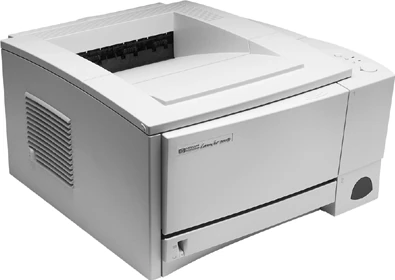
The HP LaserJet 2100xi suits an existing compatible legacy computer that needs ordinary monochrome printing from two included paper inputs. Its original US commercial package provides 4 MB RAM, a 250-sheet lower tray and a genuine 100-sheet multipurpose tray. The deciding limitation is connection: the normal setup here needs a real parallel host, correct cable and compatible driver, while Ethernet and PostScript emulation are optional.
HP's exact US record identifies C4139A and explicitly marks the model discontinued. The original HP ordering sheet separately names this exact xi package as US Commercial, distinguishing it from the Canadian C4170A base package. This is an earlier reference without a current-stock promise. The original family technical data gives a 100–127-volt, 50/60-Hz low-voltage configuration. Check the actual machine rating rather than assuming another regional edition is interchangeable.
Optional expansion does not change the supplied ports
The exact xi comparison column establishes the included IEEE 1284 parallel interface and infrared printing. Use an actually compatible legacy parallel computer and printer driver. A USB cable cannot plug directly into that parallel port, and no converter is assumed in this review's normal arrangement.
The original ordering sheet offers EIO network cards and a separate USB/serial/LocalTalk connectivity card as accessories. Those options are not part of the original included xi setup. The 2100TN's included JetDirect server and the 2100M's standard PostScript module must not be transferred to the xi merely because the names share a number.
HP's infrared routine needs an IrDA-equipped device, appropriate port driver and printer driver, with the optical ports facing each other within one metre and a limited angle. That is different from Wi-Fi or Wi-Fi Direct. A period software bundle and historic Windows or DOS list do not promise current compatibility or current support for the bundled applications. AirPrint, Mopria and PIN-held release remain unconfirmed.
Two normal inputs provide 350 sheets
The exact xi model line confirms a 100-sheet front input plus one 250-sheet lower tray. The original family media tables use ordinary 20-lb/80-g/m² paper and establish Letter, Legal and A4 in the lower tray; those sizes also fit the supported front range. The optional third 250-sheet tray is excluded from the included 350-sheet count.
Adjust the real paper guides and the software's source, size and type to match the job. Ordinary letterhead goes face up with its top toward the printer in Tray 1. In the lower tray it goes face down with its top toward the user. Push down the lower metal lift plate during loading and keep the stack below the guide's height tabs.
Supported envelopes use Tray 1, up to ten at a time. Open and fully extend the rear output bin, load the print face up and stamp end entering first, and adjust the guides without bowing the stack. A short-edge flap enters first when present. Select the actual envelope size and type in compatible software; ordinary-sheet and envelope counts are separate.
Manual duplex is an attended paper routine
The original two-sided routine prints the first sides normally and reloads second sides through Tray 1 with the printed face down. Long-edge binding uses the top edge toward the printer; short-edge binding uses the bottom edge. Odd/even controls exist in some original PostScript drivers or applications, but installed PostScript is not assumed for this optional-language xi package.
The refeeding process does not satisfy automatic duplex. This is also a monochrome print-only machine without document scanning, copying, a flatbed, feeder or fax. Printer-management and communication software cannot add that hardware.
Understand what the old declarations establish
HP declares a 10-ppm engine, but the read original sections do not explicitly identify that as one-sided Letter speed. The strict Letter field remains unconfirmed. The declared 15,000-page maximum monthly duty is separate from a recommended monthly range, which has not been established.
The original C4096A cartridge declaration is approximately 5,000 pages at historical 5% coverage, density three and EconoMode off, with no ISO basis or installed-toner remainder inferred. The exact xi comparison gives a rounded 16-by-17-inch body footprint; height and operating weight remain unconfirmed rather than using shipping figures. Allow loading, rear-output, cable and cartridge access. Choose the xi for a verified legacy parallel setup; essential included networking, USB or unattended duplex needs different documented hardware.
Key details at a glance
| Color printing | No |
|---|---|
| Scanner | No |
| Copying | No |
| Fax | No |
| Flatbed scanner | No |
| Automatic document feeder | No |
| Automatic two-sided printing | No |
| Automatic two-sided scanning | No |
| Single-pass two-sided scanning | No |
| Color scanning | No |
| Instructed envelope handling | Yes |
| Maximum monthly duty | 15000 pages |
| Included ordinary-paper capacity | 350 sheets |
| Unit-body width | 16 in |
| Unit-body depth | 17 in |
| Imaging engine | laser |
Use the exact model’s instructions for operating limits, supplied equipment and version differences.
Paper, software and setup details
Print-rate conditions
Original HP declares a 10-ppm engine but the actually read original sections do not explicitly label that number as one-sided Letter speed. The strict Letter speed field remains unknown. Original technical data declares up to 15,000 pages maximum monthly duty. A recommended monthly range remains unconfirmed and is not inferred from maximum duty.
Paper handling
Exact 2100xi original model line establishes front 100 plus lower 250, total 350 ordinary sheets. The original family media tables use 20-lb/80-g/m² paper and positively establish Letter, Legal and A4 in the lower input and front range. Optional third 250-sheet tray excluded. Front ordinary letterhead face up/top toward printer; lower face down/top toward user, metal lift plate pushed down and stack below tabs. Up to ten envelopes use front input face up/stamp end first, short-edge flap first when present; rear output open and fully extended, correct envelope size/type selected. Manual second sides feed printed face down, top first for long-edge or bottom first for short-edge binding.
Scanning arrangement
Original monochrome print-only architecture has no document scanner, automatic document feeder, flatbed, copier or fax. Printer infrared communication, JetSend and job-cancel controls do not add document-capture hardware.
Computer and mobile connections
Exact 2100xi comparison column establishes IEEE1284 parallel and infrared. Normal plan needs actual compatible legacy parallel computer, correct cable and printer driver. Ethernet server, PostScript module and USB/serial/LocalTalk EIO card are options, not included. Original optical IrDA routine needs compatible device/port driver/printer driver, facing ports within one metre and limited angle; it is not Wi-Fi or Wi-Fi Direct. No converter, AirPrint or Mopria route assumed.
Supplies and declared yields
Exact original ordering table identifies C4096A UltraPrecise cartridge. HP declares approximately 5,000 pages under historical 5%-text-coverage conditions, with print density three and EconoMode disabled in the user guide. No ISO basis or current supplied/remaining-toner promise is inferred. Original cartridge declaration is not a live cost-per-page calculation.
Software and support
Use an actually compatible printer driver, host port and cable. Original manual duplex prints the first sides normally, then feeds second sides from Tray 1 printed side down: top edge toward printer for long-edge binding, bottom edge toward printer for short-edge binding. Some original PostScript Windows drivers/applications offer odd/even pages; do not infer PostScript installation on a package where optional. No automatic duplex mechanism. Period operating-system lists do not guarantee present compatibility. AirPrint, Mopria and PIN-held document release remain unconfirmed.
Electrical edition and setup
Actual HP US C4139A discontinued identity and the original exact US Commercial ordering row establish the xi package, distinct from Canadian base C4170A. The original family low-voltage specification is 100–127 V at 50/60 Hz; check the actual plate and do not convert operating voltage. The exact xi comparison gives a rounded body footprint of 16 W × 17 D inches. Height and operating weight remain unknown; shipping measurements are excluded. Allow paper loading, rear output, cables and cartridge access.
Sources for this assessment
- HP original LaserJet 2100, 2100M and 2100TN User Guide, C4170-90901 Second Edition January 2002
- HP original 1999 selection brochure, exact 2100xi/M/TN spread on printed pages 8–9
- HP-authored LaserJet 2100/2100M/2100TN Technical Data, 5968-2780EUC, copyright 1998, printed USA
- HP US exact LaserJet 2100xi C4139A identity and discontinued notice
Find a printer for your routine.
Match color output, scanning, connections and paper handling, then compare the exact models.