
Your needs, this model
Does it fit your priorities?
Can a genuine compatible parallel computer print Legal documents with 600 ordinary sheets?
Qualifies with earlier references enabled and connection left flexible. The base 4050 requires the actual legacy host, correct cable and driver; the included front 100 and lower 500 support ordinary Legal.
Explore this need in the finder →Does the base 4050 include the N model’s Ethernet server?
Fails included Ethernet. The base package has parallel and serial interfaces; the JetDirect network server is optional.
Explore this need in the finder →Can the included base printer release a confidential document with a PIN?
Fails included PIN release. The documented four-digit Private Job workflow requires an optional printer hard disk and a configured compatible driver.
Explore this need in the finder →The base configuration needs a real legacy connection
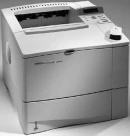
The HP LaserJet 4050 fits an existing compatible legacy computer producing monochrome documents from a large ordinary-paper stack. Its original base package includes one 500-sheet lower tray and a genuine 100-sheet multipurpose input. The deciding compromise is hardware scope: Ethernet, the Fast InfraRed receiver, automatic duplex assembly and job-storage hard disk are options rather than included base features.
HP's exact US product record identifies C4251A and explicitly marks the model discontinued. This review concerns the documented US low-voltage configuration, with no current-stock claim. The original electrical table gives 100–127 volts at 50–60 Hz separately from a 220–240-volt regional edition. Verify the individual unit's rating plate.
Start with the actual host, cable and driver
The base configuration has 8 MB RAM and includes bidirectional IEEE 1284 parallel and nine-pin RS-232 serial interfaces. The ordinary plan here uses a genuinely compatible legacy parallel computer and the correct cable. None of those ports is a USB host connection, and an unverified converter is not included in the recommendation.
The family brochure describes network cards and infrared printing, but its exact model lines reserve the included JetDirect 10/100Base-TX server and Fast InfraRed receiver for N/TN packages. They remain optional for the base 4050. Selecting Ethernet, USB or Wi-Fi therefore excludes this standard arrangement; a flexible connection can include it only with the visible legacy-host condition.
Use an actually compatible printer driver. PCL 6, PCL 5e and PostScript Level 2 emulation are documented, but period DOS, Windows and other operating-system lists do not establish present compatibility. No AirPrint or Mopria arrangement is confirmed here.
Work from the included 600 ordinary sheets
The 600-sheet input total combines Tray 1's 100 sheets with one 500-sheet lower tray, using ordinary 20-lb/75-g/m² paper. The exact base/N lower-tray table explicitly supports Letter, Legal and A4; those sizes also fit the front input's supported range. Heavier and thicker stock can reduce actual capacity.
For ordinary preprinted paper, Tray 1 takes the print face up and the top short edge toward the printer. Lower-tray paper goes face down with the top toward the user. Adjust the real guides, then match paper source, size and type in the compatible application or driver. Front input can carry a suitable alternate stock while the lower tray remains loaded.
Up to ten supported envelopes use Tray 1. Leave the front tray extension unextended for that routine, open and extend the rear output bin, and place the print face up with the postage end toward the printer. Adjust guides and envelope settings. The 75-envelope power feeder and additional 500-sheet feeder are optional accessories, not part of the included capacity.
Two separate options control duplex and PIN release
The C4123A automatic duplex assembly is optional. Without it, the included base 4050 does not satisfy an unattended two-sided printing requirement. The number of paper trays and a two-sided software choice do not establish that the hardware is fitted.
Private Job is a real documented feature, but its prerequisite matters: HP says job-retention functions require a printer hard disk and correctly configured driver. The four-digit PIN is selected in that driver and entered through the control panel to release the job. The disk is optional, so this base package does not qualify for included PIN-held release.
The printer is monochrome print-only, with no document scanner, feeder, flatbed, copier or fax. Storage, infrared communication and network management cannot add document-capture hardware.
Assess the historical ratings without inventing ownership costs
HP declares up to 17 one-sided Letter pages per minute, separately 16 A4, and a maximum monthly duty of 65,000 pages. These are maker figures, not measurements here. No recommended monthly range is established, so maximum duty is not substituted for a routine workload recommendation.
Original C4127A and C4127X cartridge declarations are approximately 6,000 and 10,000 pages under historical 5%-coverage, density-three, EconoMode-off conditions. They do not promise remaining toner in a particular used printer. Original body measurements conflict across the guide and comparison brochure; strict dimensions and operating weight remain unconfirmed. Allow paper, rear-output, cable and cartridge access. Choose the base 4050 for a verified legacy setup; essential modern connectivity or included duplex/PIN release calls for different documented equipment.
Key details at a glance
| Color printing | No |
|---|---|
| Scanner | No |
| Copying | No |
| Fax | No |
| Flatbed scanner | No |
| Automatic document feeder | No |
| Automatic two-sided printing | No |
| Automatic two-sided scanning | No |
| Single-pass two-sided scanning | No |
| Color scanning | No |
| Instructed envelope handling | Yes |
| Supported PIN-release printing | No |
| Maximum monthly duty | 65000 pages |
| Included ordinary-paper capacity | 600 sheets |
| Declared one-sided mono Letter rate | 17 pages/min |
| Imaging engine | laser |
Use the exact model’s instructions for operating limits, supplied equipment and version differences.
Paper, software and setup details
Print-rate conditions
Exact original 4050 series rating is up to 17 one-sided Letter ppm, separately 16 A4. These are HP figures, not measured performance or duplex speed. The HP 4050 comparison column declares 65,000-page maximum monthly duty, separate from competitors. A maker recommended monthly range remains unconfirmed.
Paper handling
Exact base 4050 includes 100-sheet Tray 1 plus one 500-sheet lower tray, total 600 ordinary 20-lb/75-g/m² sheets. Exact base/N paper table positively lists Letter/Legal/A4 in the lower tray and front range supports those sizes. Front ordinary stock face up/top toward printer; lower stock face down/top toward user. Envelopes use Tray 1 up to ten, face up/postage end toward printer, extension unextended and rear output open/extended. Optional additional 500-sheet feeder, 75-envelope feeder and C4123A duplexer excluded.
Scanning arrangement
Actual original monochrome print-only hardware has no flatbed, document feeder, document scanner, copier or fax. Network management and optional storage do not add physical document capture.
Computer and mobile connections
Exact base 4050 includes IEEE1284 parallel and RS-232 serial, not USB. Normal plan requires an actual compatible legacy parallel computer, correct cable and printer driver. JetDirect 10/100Base-TX and Fast InfraRed receiver are optional for base; included N/TN equipment is not borrowed. No Wi-Fi arrangement established or converter assumed.
Supplies and declared yields
Actual original 4050 ordering table identifies C4127A at approximately 6,000 and C4127X at approximately 10,000 pages. Historical life is stated for Letter/A4 at 5% coverage, density three and EconoMode off. No ISO basis is substituted for that declaration, and original cartridge declarations do not promise current installed or remaining toner. No current supply price or cost per page.
Software and support
Original PCL 6, PCL 5e and PostScript Level 2 emulation require an actually compatible driver. Historical operating-system lists do not promise present-system support. The C4123A automatic duplex assembly is optional. Actual Private Job uses a four-digit PIN but requires optional printer hard disk and correctly configured driver; the included configuration does not satisfy PIN release. No AirPrint or Mopria route established.
Electrical edition and setup
Exact US model identity and original low-voltage 100–127-V 50–60-Hz configuration are documented separately from the 220–240-V edition. Check the individual rating plate; no invented US retail option code. Original body figure and HP comparison brochure disagree on width/depth and include inconsistent height-unit conversions; strict dimensions remain unknown. Original guide weight explicitly excludes cartridge, whereas brochure figures are shipping weights; strict operating weight remains unknown. Allow tray access, rear output, cables and cartridge changes.
Sources for this assessment
Find a printer for your routine.
Match color output, scanning, connections and paper handling, then compare the exact models.