
Your needs, this model
Does it fit your priorities?
Can I print color Legal duplex, scan both sides of Legal originals over Ethernet, copy, fax and release PIN jobs at 7,000 monthly pages?
Yes with earlier references enabled, compatible computer/protected-job software and a separate configured analog phone service. Legal supports print duplex and the reversing ADF within the monthly recommendation.
Explore this need in the finder →Is it a single-pass duplex scanner?
No. The exact scanner type is RADF reversing duplex, so a requirement to capture both faces in one pass is not met.
Explore this need in the finder →Can it fit a space limited to a 22-inch-deep printer body?
No. The exact unit body is 23.2 inches deep before loading and service clearance; the shallower CX410 measurement is not substituted.
Explore this need in the finder →A larger control screen for a complete document routine
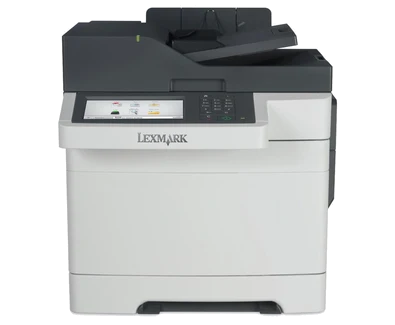
The Lexmark CX510de combines color printing, scanning, copying and analog fax with a 7-inch e-Task touchscreen. Exact US part 28E0500 includes automatic print duplex and a 50-sheet reversing duplex automatic document feeder. The control screen gives this configuration a different interface from smaller related models, but it does not change the physical capture method or supply a larger base paper stack.
Lexmark marks this model discontinued. Verify the actual region, software support, condition and included accessories of any earlier machine. This reference uses the exact US specification and original operating instructions; it does not establish present availability, remaining consumable life, measured output quality or a current service entitlement.
Reversing capture is automatic, but not single-pass
The RADF turns originals over to scan the second face. That provides automatic two-sided capture without meeting a single-pass requirement. Letter, Legal and A4 have positive feeder support. The glass serves books, individual sheets and originals unsuitable for the ADF, with positive Letter/A4 support and an explicit exclusion for Legal. A general maximum scan area should not be assigned to every route.
Simplex scanning is declared at up to 32 Letter sides per minute or 30 A4 sides per minute for black or color. Reversing duplex scanning is separately 14 Letter or 13 A4 sides per minute. Printing is another mode: maximum one-sided Letter output is 32 pages per minute in black or color, with automatic print duplex separately 15 Letter sides per minute. These are maker declarations rather than results measured by this article.
Connect each function through its documented path
The exact US page explicitly names USB or network-connected computers as scanning destinations. USB Type-B is the computer connection, while gigabit Ethernet supports shared networking. The original guide describes a network scan profile and separately conditioned Scan to Computer setup. Check the current computer software and chosen scan routine before relying on either arrangement.
The front and rear Type-A interfaces have different supported purposes from the computer port. AirPrint and Mopria use a suitable shared network and compatible applications; a USB-only computer cable does not provide that mobile arrangement. Wi-Fi requires optional MarkNet hardware rather than being included simply because mobile printing is documented.
Analog fax additionally requires the LINE connection to a suitable active analog phone service, along with fax identity, number and answer settings. Its declared 33.6-kbps modem does not mean that Ethernet or USB transports analog fax. Verify the actual phone-service setup instead of assuming an office's general VoIP connection will work identically.
Protected jobs do not require a borrowed disk feature
The guide documents compatible Print and Hold submission, a computer-set four-digit PIN and release through Held Jobs at the touchscreen. Ordinary held jobs use memory, with the usual possibility of deletion when resources are needed. The exact US hard-disk field says Not Available; the documented ordinary PIN routine does not depend on inventing an included disk or borrowing an option from another product.
Confirm the actual driver and application used for confidential submission. A generic mobile print button need not generate the same protected job. The touchscreen is a control interface for these workflows, while the color engine, scanner and paper paths remain separately specified hardware.
Paper, supplies and the installation footprint
Base input is a 250-sheet drawer plus one-sheet manual feed, quoted as 250+1 at the stated 20-pound or 75-gsm basis. Letter, Legal and A4 support the main drawer and automatic print duplex. Suitable envelopes use the separate one-sided manual routine. Optional duo input and another drawer can reach 1,450+1, but are not included in the de package.
The recommended monthly print range is 1,500–7,000 pages, distinct from the 85,000-page maximum duty figure. Supplied US toner is declared at 8,000 black pages and 4,000 for each color. Specific replacements include 80C1XK0 black and 80C1XC0, 80C1XM0 and 80C1XY0 colors with those declared ISO/IEC 19798 yields. Respect regional restrictions and Return Program conditions, keeping imaging/developer components separate and avoiding a current cost claim from yields alone.
The body is 17.48 inches wide, 23.2 deep and 18.44 high at 62 pounds. Allow scanner, loading and service access beyond those dimensions, inspect the actual electrical label and cord, and choose the supported arrangement when its reversing capture and moderate base input fit the workgroup.
Key details at a glance
| Color printing | Yes |
|---|---|
| Scanner | Yes |
| Copying | Yes |
| Fax | Yes |
| Flatbed scanner | Yes |
| Automatic document feeder | Yes |
| Automatic two-sided printing | Yes |
| Automatic two-sided scanning | Yes |
| Single-pass two-sided scanning | No |
| Color scanning | Yes |
| Instructed envelope handling | Yes |
| Apple AirPrint | Yes |
| Mopria printing | Yes |
| Supported PIN-release printing | Yes |
| Recommended monthly minimum | 1500 pages |
| Recommended monthly maximum | 7000 pages |
| Maximum monthly duty | 85000 pages |
| Included ordinary-paper capacity | 251 sheets |
| Document-feeder capacity | 50 sheets |
| Declared one-sided mono Letter rate | 32 pages/min |
| Declared one-sided color Letter rate | 32 pages/min |
| Unit-body width | 17.48 in |
| Unit-body depth | 23.2 in |
| Unit-body height | 18.44 in |
| Unit weight | 62 lb |
| Imaging engine | laser |
Use the exact model’s instructions for operating limits, supplied equipment and version differences.
Paper, software and setup details
Print-rate conditions
Maker maximum 32 one-sided Letter print pages/minute black/color; automatic print duplex separately 15 Letter sides/minute for each. Scanning separately 32 Letter/30 A4 simplex sides per minute or 14 Letter/13 A4 reversing duplex sides per minute, black/color. No measured throughput is claimed.
Paper handling
Base input is a 250-sheet drawer plus one-sheet manual feed, quoted as 250+1 at 20 lb/75 gsm. Letter/Legal/A4 support the main drawer; per-size ordinary stack is 250. Suitable envelopes use a separate one-sided manual routine. Optional paper hardware is not included. Included automatic print duplex supports Letter, Legal and A4. Optional 650-sheet duo and further 550-sheet drawer can reach 1,450+1 input; neither is included.
Scanning arrangement
Included 50-sheet RADF reverses originals to scan both faces automatically; it is not single-pass. Letter/Legal/A4 support feeder capture, while the glass supports Letter/A4 and excludes Legal. USB or network computer scanning is explicitly named in the exact US specification. Included analog fax hardware is declared at 33.6 kbps. It requires the separate LINE connection to a suitable active analog phone service and fax name/number/answer setup. Ethernet or USB computer printing/scanning does not itself transport analog fax, and generic VoIP compatibility is not promised.
Computer and mobile connections
Included USB Type-B computer connection, gigabit Ethernet and front/rear Type-A interfaces for separate supported purposes. Exact US page explicitly supports computer scanning over USB or network. Wi-Fi is optional MarkNet hardware. AirPrint/Mopria use suitable shared networking, without borrowing features into a USB-only cable arrangement.
Supplies and declared yields
US supplied black toner is declared at 8,000 pages and each color at 4,000, rather than another variant’s starter allowance. US replacements include 80C1XK0 black at 8,000 pages and 80C1XC0/80C1XM0/80C1XY0 cyan/magenta/yellow at 4,000 each. These are declared ISO/IEC 19798 yields, subject to actual use, regional compatibility and Return Program conditions. Imaging/developer components remain separate; no present cost per page is established.
Software and support
The exact scoped guide documents compatible Print and Hold, a computer-set four-digit PIN and Held Jobs panel release. Ordinary protected jobs use memory; an optional disk is not required for that routine. Check current driver/application/firmware support, since a generic mobile print button need not submit an equivalent protected job.
Electrical edition and setup
Earlier exact US reference. Verify actual part, regional supplies and current compatible software. Nominal mains input is not established; inspect the real electrical label and proper cord. Body measurements exclude scanner access, loading/service clearance and extended guides.
Sources for this assessment
Find a printer for your routine.
Match color output, scanning, connections and paper handling, then compare the exact models.