
Your needs, this model
Does it fit your priorities?
Can a wired office print Legal reports on both sides at 5,000 pages per month with at least 300 included sheets?
Yes, with earlier models included. Ethernet, Legal automatic duplex, the 300-sheet standard arrangement and the 6,000-page recommended monthly maximum fit together.
Explore this need in the finder →Can I connect this standard configuration directly to my Wi-Fi network?
No. Standard networking is 10/100 Ethernet. The external wireless print server listed by Lexmark is separate equipment.
Explore this need in the finder →Does the 80,000-page duty figure qualify it for a sustained 7,000-page monthly workload?
No. Lexmark recommends at most 6,000 pages per month; the maximum-duty figure is a different limit.
Explore this need in the finder →A wired document printer with a modest footprint
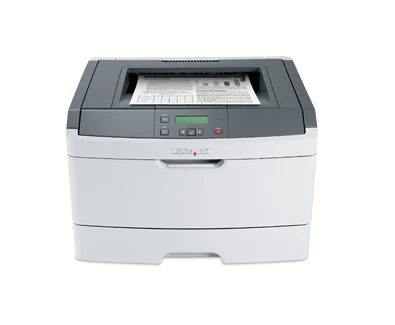
The Lexmark E360dn is a useful earlier-model reference for a small office that needs shared black-and-white printing, automatic two-sided pages and a conventional paper tray. Its included Ethernet connection is the important distinction from the USB-oriented E360d. The deciding tradeoff is connectivity: this standard configuration does not include a Wi-Fi radio, and its historical network features should not be mistaken for a promise of modern phone printing.
The exact US reference is part 34S0500, which Lexmark marks discontinued. That identifies the configuration discussed here; it does not establish present stock, warranty entitlement or the condition of a particular machine. For a used or refurbished offer, check the actual suffix, regional label, paper equipment and supported driver before treating it as a ready replacement.
Plan around the actual two-sided routine
Lexmark declares up to 40 one-sided Letter pages per minute and, separately, up to 18 Letter sides per minute in automatic duplex. A two-sided report therefore has its own rate rather than inheriting the larger simplex number. These are manufacturer specifications, not measurements from testing for this article. Document complexity, driver settings and the first page can affect an individual job.
The original paper table positively supports Letter, Legal and A4 through the standard tray, multipurpose feeder and duplex path. That makes it plausible for ordinary contracts and office reports, including Legal duplex work. The engine and duplex path have a 60–90 gsm paper range in the guide; specialty media follow different limits. There is no scanner, document feeder, copier or fax in this print-only machine. Two-sided printing cannot automate the capture of a two-sided original.
Ethernet sharing and a separate desktop cable
Standard ports include USB Type-B, IEEE 1284 parallel and 10/100 Ethernet. Use the USB computer interface for one directly attached workstation or the Ethernet port for a supported shared-network print arrangement. The two-line grayscale display is an operator panel, not a touchscreen or evidence of color output. The US box list excludes the Ethernet, USB and parallel connection cables.
Lexmark lists external print servers as accessories, including a wireless option. They do not turn the normal E360dn package into a built-in wireless printer. Likewise, Bonjour, AppleTalk and IPP in an old protocol list do not by themselves establish AirPrint or Mopria. If phone printing is essential, choose a model with an explicit supported mobile route and check its current setup requirements. For this model, verify the actual computer and driver combination first.
Count the included paper before the expansion limit
The standard 300-sheet capacity consists of a 250-sheet tray and a 50-sheet multipurpose feeder, on the stated 20-pound or 75-gsm basis. An office can keep the main tray for everyday paper and use the multipurpose source for a separate instructed media job. Envelopes belong in that feeder and are one-sided; they do not use the automatic duplex path.
The published 850-sheet maximum requires an optional 550-sheet drawer. A smaller 250-sheet option is also listed, but only one additional drawer may be installed. Neither option is included in the standard 300-sheet configuration. Lexmark recommends 740–6,000 pages monthly, separately from the 80,000-page maximum duty cycle. An office expecting 7,000 routine pages should compare a machine whose recommended range covers that demand rather than relying on the much larger duty number.
Consumables and the practical comparison
The supplied Return Program cartridge was declared at 2,300 pages. US replacement examples include E260A11A at 3,500 pages and E360H11A at 9,000 under ISO/IEC 19752. The E260X22G photoconductor is a separate service item with a different, up-to-30,000-page declaration. Match geographic compatibility and cartridge-program conditions; these yields alone do not establish today's running cost or the toner remaining in an older unit.
The body measures 15.98 inches wide, 14.55 deep and 10.2 high, weighing 30.43 pounds. Allow additional space for loading, extended paper supports, cables and service access. The technical reference distinguishes a 110–127 V low-voltage edition from higher-voltage versions, so check the actual label rather than assuming universal power. Choose this reference when wired mono printing and the recommended workload fit. Compare an explicitly wireless model for a cable-free network, or a multifunction printer when originals must also be scanned.
Key details at a glance
| Color printing | No |
|---|---|
| Scanner | No |
| Copying | No |
| Fax | No |
| Flatbed scanner | No |
| Automatic document feeder | No |
| Automatic two-sided printing | Yes |
| Automatic two-sided scanning | No |
| Single-pass two-sided scanning | No |
| Color scanning | No |
| Instructed envelope handling | Yes |
| Recommended monthly minimum | 740 pages |
| Recommended monthly maximum | 6000 pages |
| Maximum monthly duty | 80000 pages |
| Included ordinary-paper capacity | 300 sheets |
| Declared one-sided mono Letter rate | 40 pages/min |
| Unit-body width | 15.98 in |
| Unit-body depth | 14.55 in |
| Unit-body height | 10.2 in |
| Unit weight | 30.43 lb |
| Imaging engine | laser |
Use the exact model’s instructions for operating limits, supplied equipment and version differences.
Paper, software and setup details
Print-rate conditions
Maker maximum 40 one-sided Letter pages/minute. Automatic duplex has a separate 18 Letter sides/minute rating; these are declared specifications, not measured throughput.
Paper handling
Included 250-sheet tray plus 50-sheet multipurpose feeder, total 300 at 20 lb/75 gsm. Letter, Legal and A4 fit both included inputs and the automatic duplex path. The 850-sheet maximum requires a separately purchased 550-sheet drawer; only one optional drawer can be fitted. Envelopes use the multipurpose feeder one-sided.
Scanning arrangement
Monochrome print-only hardware. Automatic print duplex does not add a scanner, copier, fax or document feeder.
Computer and mobile connections
Included USB Type-B, IEEE 1284 parallel and 10/100 Ethernet. External wireless and faster print servers are options, not built-in connectivity. AirPrint, Mopria and Wi-Fi Direct are not established by the read sources.
Supplies and declared yields
Supplied Return Program toner is declared at 2,300 ISO/IEC 19752 pages. US replacement examples are E260A11A at 3,500 pages and E360H11A at 9,000; E260X22G photoconductor is a separate item rated up to 30,000 pages. Match region and program conditions.
Software and support
Use a compatible computer print driver. Historical operating-system, Bonjour, AppleTalk or IPP listings do not establish AirPrint or Mopria, and do not guarantee current software support.
Electrical edition and setup
US part 34S0500 and the exact-model technical reference establish a regional low-voltage version rated nominal 110–127 V, 50–60 Hz. This is not universal voltage; check the actual unit label and cord, especially for imports. The maker discourages converters and inverters.
Sources for this assessment
Find a printer for your routine.
Match color output, scanning, connections and paper handling, then compare the exact models.