
Your needs, this model
Does it fit your priorities?
Can I print two-sided Legal paperwork over office Wi-Fi at 9,000 monthly pages and release supported computer jobs with a PIN?
Yes, with earlier models included and a compatible Confidential Print driver. Built-in Wi-Fi, Legal duplex, PIN release and the 10,000-page recommended maximum fit the same configuration.
Explore this need in the finder →Can I require 500 included Letter sheets without buying another drawer?
No. Standard input is 250 plus 50, totaling 300 sheets. The drawer that raises capacity is optional.
Explore this need in the finder →Does the built-in wireless interface establish an AirPrint route from my iPhone?
No supported AirPrint route is established in the read sources. Ordinary infrastructure Wi-Fi is not equivalent to confirmed AirPrint compatibility.
Explore this need in the finder →Wireless sharing is the defining feature
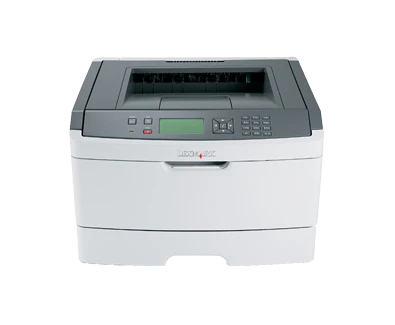
The Lexmark E460dw is an earlier monochrome printer for a small office that wants to place a shared document printer on its Wi-Fi network. Built-in 802.11b/g/n wireless, Ethernet and automatic duplex are included in the exact US configuration. The useful security routine is driver-based PIN release. The main tradeoff is that ordinary wireless networking does not establish every modern phone-printing protocol, and the included paper supply is smaller than the expansion headline.
Lexmark marks US part 34S0600 discontinued. Treat it as a documented reference for a specific machine, not an assurance of current stock or software support. The suffix matters: an E460dn has wired networking as standard, while this E460dw includes the wireless radio. Verify the actual regional unit and its working configuration before comparing an offer.
A computer print job over the chosen network
The included network choices are 10/100 Ethernet and infrastructure Wi-Fi, with USB Type-B available for a directly connected computer. A specification saying the Ethernet port also works with 1000Base-T refers to network compatibility; it does not turn the port into gigabit hardware. The original wireless instructions require a working network, its name and matching security settings. A compatible computer driver remains part of the arrangement.
Older ad hoc instructions are not a Wi-Fi Direct certification. Likewise, Bonjour or other historical protocol names do not independently establish AirPrint or Mopria. If phone printing is essential, select an explicitly documented mobile arrangement instead of assuming any Wi-Fi printer will work. The US page also contains inconsistent USB-cable box wording, so establish the actual cables supplied with the machine rather than relying on that list.
Confidential pages wait for a person at the panel
The original E460dn/E460dw/E462dtn guide describes Confidential Print in concrete terms. A supported computer driver assigns a user name and a four-digit PIN, then holds the job in printer memory. At the machine, the user selects the held job and enters that PIN to print or delete it. The four-line grayscale panel and keypad serve this release routine; they do not indicate color printing or a scanner.
This is useful when a document should not immediately arrive in a shared output bin. It is not a promise that every application or mobile service can create such a job. The guide warns that memory demands can delete retained jobs, and confidential jobs are removed after printing. Check the compatible driver and release sequence before relying on this workflow for everyday staff use.
Keep duplex speed and paper capacity separate
Lexmark declares up to 40 one-sided Letter pages per minute and separately up to 18 Letter sides per minute for automatic duplex. These are maker specifications, not results from hands-on testing for this article. Letter, Legal and A4 are positively supported in the ordinary inputs and duplex path. The guide's duplex paper range is 60–90 gsm; envelopes instead use the instructed one-sided multipurpose path.
Standard input is a 250-sheet tray plus a 50-sheet multipurpose feeder, totaling 300 sheets on the 20-pound or 75-gsm basis. Only one optional 250- or 550-sheet drawer may be added; the 850-sheet figure requires the larger accessory. Lexmark recommends 1,500–10,000 pages per month. The 80,000-page maximum duty cycle is separate and should not be treated as the routine recommended workload. This machine only prints: scanning, copying and fax require other hardware.
Supplies and space determine whether it fits
The original supplied Return Program cartridge is declared at 7,000 ISO/IEC 19752 pages. US replacements include E260A11A at 3,500, E360H11A at 9,000 and E460X11A at 15,000 pages. The E260X22G photoconductor is separate, with an up-to-30,000-page declaration. Match the region and program conditions, and establish actual supply status; yield alone does not tell you current running cost.
The documented body is 15.9 inches wide, 14.55 deep and 10.2 high, at 30.91 pounds. The same US page gives a 23-inch depth with trays extended, which is a better warning for a shallow shelf. Confirm the unit's electrical label and operating access. This reference fits a compatible computer-based wireless mono routine; compare a newer explicitly mobile-capable model for phone printing or a multifunction machine for document capture.
Key details at a glance
| Color printing | No |
|---|---|
| Scanner | No |
| Copying | No |
| Fax | No |
| Flatbed scanner | No |
| Automatic document feeder | No |
| Automatic two-sided printing | Yes |
| Automatic two-sided scanning | No |
| Single-pass two-sided scanning | No |
| Color scanning | No |
| Instructed envelope handling | Yes |
| Supported PIN-release printing | Yes |
| Recommended monthly minimum | 1500 pages |
| Recommended monthly maximum | 10000 pages |
| Maximum monthly duty | 80000 pages |
| Included ordinary-paper capacity | 300 sheets |
| Declared one-sided mono Letter rate | 40 pages/min |
| Unit-body width | 15.9 in |
| Unit-body depth | 14.55 in |
| Unit-body height | 10.2 in |
| Unit weight | 30.91 lb |
| Imaging engine | laser |
Use the exact model’s instructions for operating limits, supplied equipment and version differences.
Paper, software and setup details
Print-rate conditions
Maker maximum 40 one-sided Letter pages/minute. Automatic duplex has a separate 18 Letter sides/minute rating; these are declared specifications, not measured throughput.
Paper handling
Standard 250-sheet tray plus 50-sheet multipurpose feeder: 300 ordinary sheets on the 20 lb/75 gsm basis. Letter/Legal/A4 fit both included inputs and automatic duplex. Optional 250- or 550-sheet drawer, one at a time; 850 is not included. Envelopes use the multipurpose source one-sided.
Scanning arrangement
Monochrome print-only hardware. Automatic print duplex does not add a scanner, copier, fax or document feeder.
Computer and mobile connections
Included USB Type-B, 10/100 Ethernet and 802.11b/g/n infrastructure Wi-Fi. Compatibility with a 1000Base-T network does not make the port gigabit. Ad hoc instructions do not establish Wi-Fi Direct; AirPrint/Mopria remain unknown.
Supplies and declared yields
Supplied Return Program toner declared 7,000 ISO/IEC 19752 pages. Exact US replacement examples E260A11A 3,500, E360H11A 9,000 and E460X11A 15,000 pages; E260X22G separate photoconductor up to 30,000. Match geographic and program conditions.
Software and support
Use a compatible computer driver. Confidential Print/Print and Hold creates a four-digit PIN and holds the job in printer memory until panel release; memory pressure can remove held jobs. This does not establish PIN submission from every app or modern mobile protocol.
Electrical edition and setup
US part 34S0600, nominal low-voltage version 110–127 V at 50–60 Hz per exact-model technical table. Check the actual unit label/cord; it is not universal voltage. Body depth 14.55 inches is separate from the exact US trays-extended depth 23.0 inches.
Sources for this assessment
Find a printer for your routine.
Match color output, scanning, connections and paper handling, then compare the exact models.