
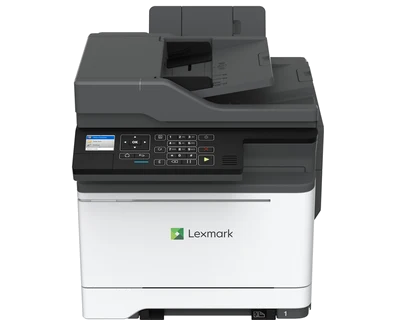
Your needs, this model
Does it fit your priorities?
Can I print color Legal reports on both sides over Ethernet, scan one-sided Letter stacks and use analog fax for a 4,500-page monthly routine?
Yes, with earlier models enabled, compatible computer software and a separately configured telephone fax connection. The simplex Letter feeder and Legal print-duplex path are distinct supported routines.
Explore this need in the finder →Can it automatically scan both sides of a Letter stack without turning originals myself?
No. Lexmark explicitly specifies a simplex feeder. Automatic print duplex does not provide automatic two-sided capture.
Explore this need in the finder →Can the standard Letter arrangement provide 500 included input sheets?
No. The exact model lists 250 sheets plus one-sheet manual feed as both standard and maximum; family add-on drawers are not assigned to it.
Explore this need in the finder →Color office work with a single-sided feeder
The Lexmark MC2325adw suits a small workgroup that combines color printing, copying, ordinary document scanning and analog fax. Included Wi-Fi and Ethernet make sharing practical, while automatic print duplex can reduce paper use. The deciding scanning limitation is the 50-sheet simplex feeder: it reads one side of each original, rather than automatically capturing both sides.
Lexmark marks exact US part 42CC410 discontinued. This is an earlier configuration reference for an installed printer or a clearly identified offer, not a claim of current stock. Confirm the actual suffix, regional unit, working software and supplies. Nearby MC2425 and MC2535 variants change feeder and paper-expansion capabilities, so a family name alone is insufficient.
Keep printing, copying and capture separate
The manufacturer declares up to 25 one-sided Letter pages per minute in black or color. Automatic duplex printing is separately rated at 12.5 Letter sides per minute. Those are maker specifications, not measured results from testing for this article. The automatic print-duplex path supports Letter, Legal and A4 in the original media table.
The scan table specifies simplex operation, with up to 50 black or 32 color Letter sides per minute. Those scanning rates are not print rates or automatic two-sided capture figures. Letter and A4 scan routes are positively documented, while the glass maximum is 8.5 by 11.7 inches. Legal printing should not be used to claim a Legal flatbed or an unverified Legal feeder route. Use the glass for a book page or delicate item and the feeder for a suitable one-sided stack.
Choose the connection for the document routine
Standard interfaces include USB Type-B, gigabit Ethernet and 802.11b/g/n Wi-Fi. The exact scan destinations include either a USB-connected or network-connected computer. The original guide also describes ScanBack profiles using the printer's IP address on a shared network. A compatible driver or scanning utility remains part of that arrangement.
AirPrint and Mopria are documented network printing choices. They do not mean a direct USB computer cable provides the same mobile route. Analog fax uses its separately configured telephone connection; it is not a feature of the Ethernet socket. The 2.4-inch color LCD and keypad provide controls without a touchscreen, which may matter if staff regularly select scan profiles or document settings.
The paper supply has no larger expansion promise
Included and maximum input are both 250+1 on the stated 20-pound or 75-gsm basis: a 250-sheet tray and a one-sheet manual feed. An occasional envelope or alternate sheet follows the instructed media routine, but the manual slot is not another substantial stack. Do not assign the larger expansion drawers available on other family members to this exact model.
Lexmark recommends 500–5,000 printed pages per month, separately from the 60,000-page maximum duty figure. Refilling and workload should be assessed against that real standard arrangement. The original guide also supports confidential computer jobs through a compatible Print and Hold driver and four-digit PIN release at the panel. Memory-held work is lost when the printer is powered off; optional-disk protections and storage features are separate.
Supplies and the alternative that changes the choice
The supplied toner is declared at 1,400 black pages and 750 for each color under ISO/IEC 19798. Exact US high-yield replacements include C231HK0 black at 3,000 and C231HC0, C231HM0 and C231HY0 colors at 2,300 each. Larger yields listed for other family members are not assumed compatible. Match geographic and Return Program conditions without treating yield as today's cost per page.
The body is 17.4 inches wide, 21.9 deep and 18.2 high at 58 pounds before operating clearance. Check the actual electrical label and correct cord. This configuration is coherent when one-sided capture, fixed input and the recommended workload fit. Compare an explicitly reversing or single-pass scanner for frequent two-sided originals, or a printer with a verified larger paper arrangement when refilling is the deciding issue.
Key details at a glance
| Color printing | Yes |
|---|---|
| Scanner | Yes |
| Copying | Yes |
| Fax | Yes |
| Flatbed scanner | Yes |
| Automatic document feeder | Yes |
| Automatic two-sided printing | Yes |
| Automatic two-sided scanning | No |
| Single-pass two-sided scanning | No |
| Color scanning | Yes |
| Instructed envelope handling | Yes |
| Apple AirPrint | Yes |
| Mopria printing | Yes |
| Supported PIN-release printing | Yes |
| Recommended monthly minimum | 500 pages |
| Recommended monthly maximum | 5000 pages |
| Maximum monthly duty | 60000 pages |
| Included ordinary-paper capacity | 251 sheets |
| Document-feeder capacity | 50 sheets |
| Declared one-sided mono Letter rate | 25 pages/min |
| Declared one-sided color Letter rate | 25 pages/min |
| Unit-body width | 17.4 in |
| Unit-body depth | 21.9 in |
| Unit-body height | 18.2 in |
| Unit weight | 58 lb |
| Imaging engine | laser |
Use the exact model’s instructions for operating limits, supplied equipment and version differences.
Paper, software and setup details
Print-rate conditions
Maker maximum 25 one-sided Letter pages/minute black or color; automatic print duplex separately 12.5 Letter sides/minute. Feeder scanning is simplex at up to 50 black/32 color Letter sides/minute, not an automatic duplex scan rate.
Paper handling
Included and maximum input both 250+1 at 20 lb/75 gsm: 250-sheet tray and one-sheet manual feed. Letter, Legal and A4 fit the main tray and automatic print duplex; per-size stack capacity is 250. No expansion drawer from MC2425/MC2535 is included or assigned. Envelopes use the instructed one-sided routine.
Scanning arrangement
50-sheet simplex ADF plus flatbed, with color scanning. Letter/A4 are positively documented by the scan-rate table; glass maximum 8.5 by 11.7 inches. Legal ADF acceptance is not established by the read scanning sections, so it is not inferred from Legal printing.
Computer and mobile connections
Included USB Type-B, gigabit Ethernet and 802.11b/g/n Wi-Fi. Exact scan destinations include USB- or network-connected computer. AirPrint/Mopria are network printing routes; analog fax uses its separately configured telephone connection.
Supplies and declared yields
Supplied toner declared 1,400 black and 750 each CMY ISO/IEC 19798 pages. Exact US high-yield replacements C231HK0 black 3,000 and C231HC0/C231HM0/C231HY0 colors 2,300 each. Geographic and Return Program conditions apply; no larger family cartridge yield is borrowed.
Software and support
Use compatible print/scan software. Original guide supports Print and Hold confidential jobs with a four-digit PIN and panel release; memory-held jobs are lost when powered off. Optional-disk-only invalid-PIN controls, OCR and persistent storage are not assumed included.
Electrical edition and setup
Exact US part 42CC410 is established. Nominal electrical input is not directly established in the read original sections; verify the actual unit label and cord, especially for an imported machine. Maximum duty is not the monthly recommendation.
Sources for this assessment
Find a printer for your routine.
Match color output, scanning, connections and paper handling, then compare the exact models.