
Your needs, this model
Does it fit your priorities?
Can I print monochrome Legal documents on both sides over Ethernet at 5,000 pages monthly, with 350 included sheets and AirPrint?
Yes, with earlier references enabled and suitable shared networking. The 250-sheet main tray and 100-sheet multipurpose feeder both support Legal; automatic Legal duplex and the 6,000-page recommended maximum are documented.
Explore this need in the finder →Does the normal base printer connect to Wi-Fi without additional hardware?
No. The exact MS321dn configuration has USB and Ethernet; wireless is explicitly absent from its standard configuration.
Explore this need in the finder →Can it print color presentations through USB if the driver lists color controls?
No. Exact hardware output is monochrome. A driver interface cannot add a color print engine.
Explore this need in the finder →Wired mono printing with two useful paper inputs
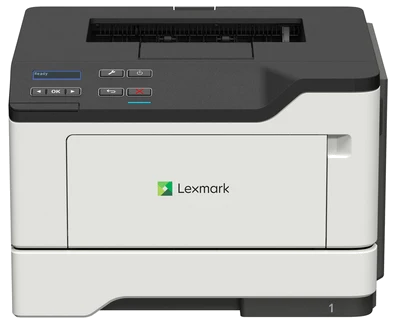
The Lexmark MS321dn suits a small workgroup that needs monochrome documents over Ethernet or a direct computer cable. Its useful paper distinction is a genuine 100-sheet multipurpose feeder alongside the 250-sheet main tray. That provides more alternate-media input than a single-sheet slot, although the optional 900-sheet maximum is a different package from the included 350 sheets.
This reference covers US part 36S0100, marked discontinued by Lexmark. It describes the documented printer rather than stock, warranty coverage or the condition of a specific offer. Check the regional unit, usable software, supplied accessories and cartridges. A similarly named B printer can add wireless while changing the toner range, so compare the exact part and configuration.
Plan ordinary Letter and Legal work
The declared print rate is up to 38 one-sided Letter pages per minute in black. Automatic duplex is separately rated at 19 Letter sides per minute. Those manufacturer figures describe different output modes and are not measurements from testing for this article. Files, application processing, pauses and paper choice can change actual job time.
Letter, Legal and A4 have positive support in the tray, multipurpose feeder and automatic two-sided print path. The original guide also separates the paper-weight limits: the standard tray supports 60–120 gsm, the multipurpose feeder 60–216 gsm, and duplex 60–90 gsm. A thick sheet fitting the alternate feeder is therefore not automatically suitable for duplex. Match the loaded paper's size and type in both the printer and application.
Use the supplied inputs before counting expansion
Included capacity is 250 sheets in the main tray plus 100 in the multipurpose feeder, stated as 350 at the 20-pound or 75-gsm basis. Both accept the supported ordinary page sizes. The alternate feeder is useful for envelopes or a separate paper stock, but choosing alternate media changes what is ready for an ordinary full-stack job. Envelopes follow the guide's one-sided feed instructions.
An optional 550-sheet drawer takes the maximum to 900 sheets; it is not supplied with the base printer. The original guide describes tray linking by matching size and type settings and enabling the appropriate linking behavior. Check the actual installed drawer and driver configuration before depending on it. Lexmark recommends 500–6,000 printed pages monthly, separately from a 50,000-page maximum duty cycle. Use the recommended range and refill pattern for routine planning.
Computer cables and mobile network printing
The exact US standard-port list includes USB Type-B and gigabit Ethernet. The original cable instructions identify the Type-B printer port as a computer connection. A separate Direct USB field should not be interpreted as removing that explicitly documented interface. The base MS321dn does not include a wireless radio.
AirPrint and Mopria are documented through suitable shared networking. A phone using office Wi-Fi can reach the printer on Ethernet under that arrangement; a direct USB cable alone does not supply the shared-network route. Confirm current software compatibility. The read operating sections do not establish a complete confidential PIN release workflow, so verify that separately if protected job collection is essential.
Print-only scope and supplies
Lexmark's support classification explicitly identifies MS321 as print-only black-and-white laser hardware. It has no scanner, document feeder, copier or fax. The two-line monochrome OLED panel reports status and settings; neither generic driver names nor network connectivity add document capture or color output.
Supplied toner is declared at 2,000 standard pages under ISO/IEC 19752. Exact US replacement choices include 56F1000 at 6,000 pages and 56F1H00 at 15,000, with the corresponding regular 56F0HA0 also rated at 15,000. The imaging unit is a separate item with its own declared estimate and use conditions. Match region and Return Program terms instead of treating yield as a live running-cost figure.
The body measures 15.7 inches wide, 14.7 deep and 10.2 high at 30.6 pounds before paper extensions and service access. Inspect the actual electrical label and cord. Choose it when wired monochrome printing and the documented input arrangement fit; compare actual wireless or multifunction hardware when those needs are essential.
Key details at a glance
| Color printing | No |
|---|---|
| Scanner | No |
| Copying | No |
| Fax | No |
| Flatbed scanner | No |
| Automatic document feeder | No |
| Automatic two-sided printing | Yes |
| Automatic two-sided scanning | No |
| Single-pass two-sided scanning | No |
| Color scanning | No |
| Instructed envelope handling | Yes |
| Apple AirPrint | Yes |
| Mopria printing | Yes |
| Recommended monthly minimum | 500 pages |
| Recommended monthly maximum | 6000 pages |
| Maximum monthly duty | 50000 pages |
| Included ordinary-paper capacity | 350 sheets |
| Declared one-sided mono Letter rate | 38 pages/min |
| Unit-body width | 15.7 in |
| Unit-body depth | 14.7 in |
| Unit-body height | 10.2 in |
| Unit weight | 30.6 lb |
| Imaging engine | laser |
Use the exact model’s instructions for operating limits, supplied equipment and version differences.
Paper, software and setup details
Print-rate conditions
Declared 38 one-sided Letter pages/minute black; automatic print duplex separately 19 Letter sides/minute. These are manufacturer modes, not measured job throughput.
Paper handling
Included 250-sheet main tray plus 100-sheet multipurpose feeder, combined 350 at 20 lb/75 gsm. Both inputs support Letter, Legal and A4; all three sizes support automatic print duplex. One optional 550-sheet drawer raises maximum to 900, but is not included. Envelopes use the multipurpose feeder in a separate one-sided routine.
Scanning arrangement
Explicitly print-only monochrome laser hardware. No paper scanner, copier, fax or document feeder; generic driver or software lists do not add hardware.
Computer and mobile connections
Included USB Type-B computer connection and gigabit Ethernet. Wireless is explicitly No in the exact US record; no standard radio or peer route established. AirPrint/Mopria operate over suitable shared network; USB computer printing is separate from front flash-drive printing.
Supplies and declared yields
Supplied toner declared at 2,000 pages under ISO/IEC 19752. US 56F1000 standard 6,000 and 56F1H00 high 15,000; regular 56F0HA0 also 15,000. Separate 56F0Z00/56F0ZA0 imaging unit estimated at 60,000 with three average Letter/A4 pages per job and about 5% coverage. Match region and Return Program conditions; no live cost derived.
Software and support
Original exact-model guide documents AirPrint and Mopria through suitable shared networking. Check current drivers and applications. Confidential PIN release is not established by the read operative sections, so verify the exact protected-job workflow before relying on it.
Electrical edition and setup
Exact US part and body measurements established. Nominal mains input is not established in the read sources; inspect the actual rating label and correct cord. Body measurements exclude working access and any extended paper guides.
Sources for this assessment
Find a printer for your routine.
Match color output, scanning, connections and paper handling, then compare the exact models.