
Your needs, this model
Does it fit your priorities?
Can an Ethernet office print two-sided Legal reports at 70,000 monthly pages with 650 included sheets and PIN release for supported computer jobs?
Yes, with earlier references included and the compatible driver. The current exact US page recommends up to 75,000 monthly pages; the older sheet gives a lower range, which should be checked against the actual unit.
Explore this need in the finder →Does the base package provide at least 1,000 included Letter sheets?
No. Standard input is 550 plus 100, totaling 650. Additional drawers are optional.
Explore this need in the finder →Can this printer also scan two-sided Letter originals to my computer?
No. It is explicitly print-only; automatic duplex describes the printing path and does not add a scanner.
Explore this need in the finder →For an office that needs two-sided mono reports
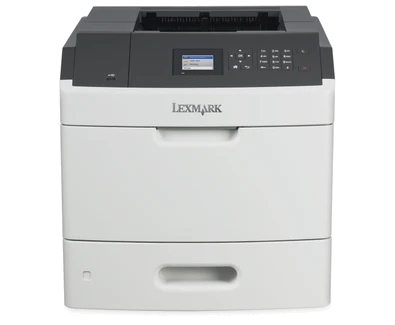
The Lexmark MS811dn is an earlier workgroup printer for shared black-and-white reports where automatic duplex matters. Gigabit Ethernet, a 550-sheet tray and a 100-sheet multipurpose source are included, while a compatible driver can hold confidential work for PIN release. Its important purchasing distinction is the standard configuration: larger input stacks and finishing devices require additional equipment, even when a series photograph shows them.
The documented US part is 40G0210, marked discontinued by Lexmark. This reference is useful for comparing an installed printer or a specific secondhand machine, rather than proving current availability. Confirm the suffix, regional label, actual paper drawers, compatible software and machine condition. The separate MS811n lacks automatic duplex and should not be treated as an interchangeable name.
Duplex has its own rate and paper path
The current exact US specification declares up to 63 one-sided Letter pages per minute. Automatic duplex is separately rated at 38 Letter sides per minute. These manufacturer figures are not results from testing for this article. A two-sided document should be planned using the relevant duplex rating rather than assuming the faster simplex figure describes its whole job.
Letter, Legal and A4 are positively supported through the standard input sources and automatic duplex path in the original guide. That connects the paper size and two-sided requirement in one actual arrangement. Specialty stocks have their own restrictions; an envelope routine is not automatic two-sided envelope printing. The 2.4-inch color LCD is an operator display, while output remains monochrome. There is no scanner, copier or fax in the print-only hardware.
Match the included paper to the workday
The standard total is 650 sheets on the stated 20-pound or 75-gsm basis: 550 in the main tray and 100 in the multipurpose feeder. An office can use the main tray for ordinary reports and configure the multipurpose source for a separate appropriate media job. The 550-sheet output bin holds finished pages; it must not be counted again as input.
Lexmark lists optional trays and finishing equipment, with input expandable to 4,400 sheets in a supported arrangement. Those accessories are not supplied merely because the base machine supports them. Identify the installed drawer, finisher and required stability equipment before assigning a larger package capacity or a stapling workflow. For an occasional envelope, follow the original media and feed instructions rather than relying on the ordinary-page stack capacity.
Network printing and a separate confidential-job method
Included connections are USB Type-B and gigabit Ethernet; the front Type-A USB port handles flash media instead of serving as the computer connection. MarkNet N8350 Wi-Fi and parallel or serial interfaces are optional. AirPrint is named on the exact US page and is assigned to a suitable shared-network arrangement, not a direct USB cable.
The guide's named MS811dn section supports four-digit PIN-held jobs through a compatible Print and Hold driver and the control panel. Printer memory retains the job, and memory pressure may remove held work. The optional hard disk is not assumed included. This routine is distinct from promising that every phone application can submit a protected job. Mopria remains unestablished here because the original mobile section qualifies availability to some models.
Read the workload and supplies with their conditions
The current exact US page recommends 5,000–75,000 pages monthly and lists a separate 300,000-page maximum duty cycle. The preserved older sheet gives 5,000–30,000 recommended pages and 275,000 maximum duty. This reference records the current exact US figures while preserving that discrepancy. Confirm the applicable documentation and condition of an older actual unit before planning around the higher recommendation; duty is never the ordinary monthly target.
The original starter toner is declared at 10,000 one-sided ISO/IEC 19752 pages. US replacement examples are 52D1000 at 6,000, 52D1H00 at 25,000 and 52D1X00 at 45,000, with a separate imaging unit and region/program conditions. The body is 16.7 inches wide, 20.1 deep and 16.5 high at 52.2 pounds, before operating clearance or accessories. If compatible wired duplex printing fits the job, this is a coherent reference. Compare actual wireless or multifunction hardware when those functions are essential.
Key details at a glance
| Color printing | No |
|---|---|
| Scanner | No |
| Copying | No |
| Fax | No |
| Flatbed scanner | No |
| Automatic document feeder | No |
| Automatic two-sided printing | Yes |
| Automatic two-sided scanning | No |
| Single-pass two-sided scanning | No |
| Color scanning | No |
| Instructed envelope handling | Yes |
| Apple AirPrint | Yes |
| Supported PIN-release printing | Yes |
| Recommended monthly minimum | 5000 pages |
| Recommended monthly maximum | 75000 pages |
| Maximum monthly duty | 300000 pages |
| Included ordinary-paper capacity | 650 sheets |
| Declared one-sided mono Letter rate | 63 pages/min |
| Unit-body width | 16.7 in |
| Unit-body depth | 20.1 in |
| Unit-body height | 16.5 in |
| Unit weight | 52.2 lb |
| Imaging engine | laser |
Use the exact model’s instructions for operating limits, supplied equipment and version differences.
Paper, software and setup details
Print-rate conditions
Current exact US specification: up to 63 one-sided Letter pages/minute, separately 38 Letter sides/minute in automatic duplex under the stated ISO method. Older metric series figures are not substituted for Letter.
Paper handling
Included 550-sheet tray and 100-sheet multipurpose feeder total 650 ordinary sheets at 20 lb/75 gsm. Letter, Legal and A4 fit both included inputs and the automatic duplex path. The 4,400-sheet maximum and finishers require optional equipment; envelopes use a separate instructed simplex routine.
Scanning arrangement
Original maker support explicitly identifies print-only monochrome laser hardware. Optional scanner equipment or a color LCD does not give this configuration scanning or color printing.
Computer and mobile connections
Standard USB Type-B computer printing and gigabit Ethernet. Front USB Type-A serves flash media. MarkNet N8350 Wi-Fi, parallel and serial interfaces are optional and excluded from these included plans.
Supplies and declared yields
Supplied starter toner declared 10,000 one-sided ISO/IEC 19752 pages. Exact US replacements include 52D1000 at 6,000, 52D1H00 at 25,000 and 52D1X00 at 45,000 pages; regular 52D0XA0 is another 45,000-page option. Separate imaging-unit yield is up to 100,000 under the stated three-page Letter/A4-job and coverage conditions. Match region and Return Program terms.
Software and support
Compatible-driver Print and Hold supports four-digit PIN release through the panel; held jobs may be deleted when memory is needed. Optional disk functions are not assumed included. Mopria in this guide is qualified to some models, so exact support remains unknown.
Electrical edition and setup
Exact US SKU and regional technical-reference low-voltage row: nominal 100–127 V at 47–63 Hz, separate from high-voltage editions. Verify the actual unit label, cord and installed hardware. Body dimensions exclude working clearance; do not use a voltage converter.
Sources for this assessment
Find a printer for your routine.
Match color output, scanning, connections and paper handling, then compare the exact models.