
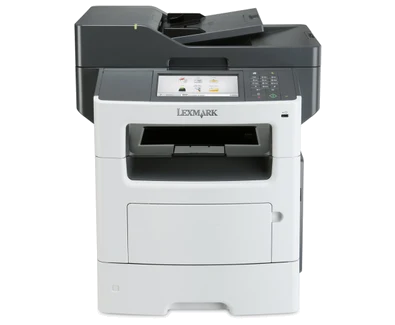
Your needs, this model
Does it fit your priorities?
Can Ethernet combine fax, Legal glass, Legal duplex feeder scans and 650-sheet Legal duplex printing?
Yes with compatible network scan setup and a suitable separate analog phone line. The exact de package supports these ordinary routines without borrowing an optional drawer or disk.
Explore this need in the finder →Can USB provide PIN-held Letter duplex jobs for 15,000 monthly pages?
Yes with compatible Print and Hold software, local release and proper ordinary paper. The exact recommendation reaches that monthly volume.
Explore this need in the finder →Can the included configuration meet 1,000-sheet Legal input and single-pass scanning?
No. Standard input is 650 sheets and the feeder reverses originals. Optional drawers do not change the scanner into a single-pass mechanism.
Explore this need in the finder →Fax and substantial standard input in one wired MFP
The Lexmark MX611de fits an office that combines monochrome document printing with conventional fax and mixed scanning routines. US part 35S6701 includes a 7-inch touchscreen, a 550-sheet main drawer, a 100-sheet multipurpose feeder and a 50-sheet reversing document feeder. Its 650-sheet standard input is useful before considering any expansion hardware.
The exact de package matters. It includes fax, unlike the MX610de, but lists its hard disk as optional, unlike the MX611dhe. Inline stapling, additional drawers and wireless also require optional hardware. A photo, family name or shared guide should not turn those options into items included with an offered unit.
Two-sided originals and flat Legal material
Letter, Legal and A4 are supported on the scanner glass and through the feeder. The glass offers an established full-length Legal route for originals that should stay flat. It is also the appropriate surface for books, photographs, small items and thin or fragile material unsuited to rollers.
For suitable loose pages, load the feeder faceup, short edge first, and set its guides. Automatic two-sided capture reverses each sheet rather than using a single-pass mechanism. That distinction matters for recurring batches even when both mechanisms are described as automatic duplex scanning.
The maker's Letter scanning modes reach 48 black or 32 color sides per minute in simplex, with duplex separately 21 black or 14 color sides. These are not measured complete processing times for a particular file or destination. Scanning can retain color, while copies and printed output remain monochrome.
Computer scanning and telephone fax are different paths
The exact US page confirms computer scanning over USB or a network. USB Type-B attaches a workstation; gigabit Ethernet supplies standard shared networking. The guide describes creating a computer scan profile, choosing a destination and initiating it at the printer. Check that the needed software and destination permissions work on the intended current system.
Front flash-drive printing and scanning have file and FAT-format restrictions. The Type-A interfaces are distinct from the Type-B computer connection. AirPrint is explicitly listed for suitable shared networking, but it does not create an included wireless radio. Wireless attachment needs an optional N8350 interface.
The analog fax modem requires a suitable separate telephone connection and station information. Configure that actual line or adapter arrangement and confirm its service compatibility. Ethernet supports computer networking rather than replacing the ordinary analog fax transport. A general network setup alone is therefore not the complete fax installation.
Confidential output and normal paper loads
Compatible computer Print and Hold software submits confidential work with a four-digit PIN for local release; this guide specifies digits 1–9. Memory pressure, expiration and invalid attempts affect stored jobs. The ordinary held-job routine should be distinguished from optional disk-based functions and advanced PDF modes with additional OCR, RAM or storage requirements.
The included 550-sheet drawer and 100-sheet multipurpose feeder provide 650 sheets on the stated 20-pound or 75-gsm basis. Letter, Legal and A4 fit both inputs and automatic duplex. Match size and type settings to each load. Suitable envelopes use a separate one-sided feeder routine; output capacity is separately 250 sheets.
Extra drawers are needed for the 2,300-sheet maximum. Printing is declared up to 50 one-sided Letter pages per minute, with duplex separately 22 Letter sides per minute. The 2,000–15,000-page recommended monthly range is distinct from the exact US 175,000-page maximum duty rating.
Supplies and installation space
The original US starter declares 7,500 pages. Listed toner replacements are 60F1000 at 2,500, 60F1H00 at 10,000 and 60F1X00 or 60F0XA0 at 20,000 under ISO/IEC 19752. The separate 60,000-page imaging unit has a different job and coverage basis. Match regional and Return Program conditions.
Lexmark marks the model discontinued. Inspect the offered unit, compatible software, supplies, electrical label and installed options. Leave scanner-cover, loading and service access around the 52-pound body. A confirmed single-pass or standard-wireless configuration is the sensible comparison when either capability is central to the job.
Key details at a glance
| Color printing | No |
|---|---|
| Scanner | Yes |
| Copying | Yes |
| Fax | Yes |
| Flatbed scanner | Yes |
| Automatic document feeder | Yes |
| Automatic two-sided printing | Yes |
| Automatic two-sided scanning | Yes |
| Single-pass two-sided scanning | No |
| Color scanning | Yes |
| Instructed envelope handling | Yes |
| Apple AirPrint | Yes |
| Supported PIN-release printing | Yes |
| Recommended monthly minimum | 2000 pages |
| Recommended monthly maximum | 15000 pages |
| Maximum monthly duty | 175000 pages |
| Included ordinary-paper capacity | 650 sheets |
| Document-feeder capacity | 50 sheets |
| Declared one-sided mono Letter rate | 50 pages/min |
| Unit-body width | 19.3 in |
| Unit-body depth | 18.9 in |
| Unit-body height | 22.1 in |
| Unit weight | 52 lb |
| Imaging engine | laser |
Use the exact model’s instructions for operating limits, supplied equipment and version differences.
Paper, software and setup details
Print-rate conditions
Exact US maximum 50 one-sided Letter pages/minute; automatic duplex printing separately 22 Letter sides/minute. Letter scans separately up to 48 black/32 color simplex and 21 black/14 color duplex sides/minute.
Paper handling
Included 550-sheet drawer plus 100-sheet MPF: 650 sheets at 20 lb/75 gsm, with separate 250-sheet output. Letter/Legal/A4 fit both inputs and automatic ordinary-paper duplex. Maximum 2,300 and inline stapling need optional hardware. Suitable envelopes use MPF simplex.
Scanning arrangement
50-sheet CCD reversing duplex ADF, not single-pass. Guide 15 and visually inspected 74 confirm Letter/Legal/A4 on both glass and feeder. USB/network computer destinations and scan profiles are explicit.
Computer and mobile connections
Included gigabit Ethernet, USB Type-B and front/rear Type-A. N8350 Wi-Fi and parallel/serial interfaces are optional. Exact US AirPrint uses suitable shared networking; conditional guide 79 does not establish exact Mopria support.
Supplies and declared yields
US starter Return Program toner 7,500 pages. Replacements 60F1000 2,500; 60F1H00 10,000; 60F1X00/60F0XA0 20,000 under ISO/IEC 19752. Separate 50F0Z00/50F0ZA0 imaging unit 60,000 uses its own job/coverage basis.
Software and support
Guide 82–83 supports compatible computer Print and Hold, a four-digit PIN using 1–9 and local release; memory/expiration/invalid-attempt limits apply. Hard disk is optional on de, unlike dhe. Specified advanced PDF features have OCR, RAM and disk conditions; front flash has FAT/file restrictions.
Electrical edition and setup
Included analog fax requires station information and a suitable separate telephone-line/adapter arrangement. Ethernet is not its analog fax transport. Verify electrical label, usable current software, actual options and operating clearance around the body.
Sources for this assessment
Find a printer for your routine.
Match color output, scanning, connections and paper handling, then compare the exact models.