
Your needs, this model
Does it fit your priorities?
Can base USB combine PIN-held Legal printing with 600 sheets of ordinary input?
Yes with compatible Lexmark custom drivers and at least 16 MB available printer memory. Legal fits both included inputs; PIN release uses digits 1–6.
Explore this need in the finder →Can USB handle A4 monochrome documents and occasional envelopes?
Yes through the ordinary A4 sources and separate one-sided MPF envelope routine with suitable stock and matching settings.
Explore this need in the finder →Is automatic duplex supplied with the base T632?
No. The matching 500-sheet duplex unit is listed as optional equipment. Confirm an installed unit or choose an explicitly equipped configuration.
Explore this need in the finder →More base paper for a local monochrome queue
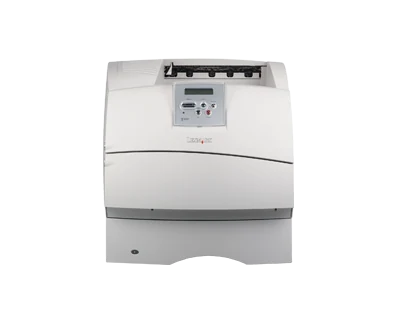
The Lexmark T632 base model has a 500-sheet drawer and 100-sheet multipurpose feeder, giving a larger supplied load than T630. Exact US part 10G0300 provides USB and parallel computer interfaces for monochrome laser printing. It is useful to assess when an existing or offered earlier machine needs to handle ordinary documents and local confidential-job release.
The base package does not include network connectivity or automatic duplex. Both have separately listed options. This is also print-only hardware: references to adding multifunction capability do not supply a scanner, copier or fax. Lexmark marks T632 discontinued, so compatible software, maintenance condition and actual installed hardware deserve attention.
Establish the computer workflow and available memory
USB Type-B is the supported included computer arrangement here. The parallel interface serves a separate legacy route, and two internal card slots provide expansion possibilities. An empty slot or optional network-server listing does not prove an installed Ethernet interface.
The original guide describes selecting the correct printer and changing job settings through compatible software. Match size, type and source to the loaded media. Confirm the actual operating system and application rather than treating an old driver list as current universal support.
Confidential printing specifically uses compatible Lexmark custom drivers. Submit a four-digit PIN made from digits 1–6. At the printer, select Confidential Job and the user name from the Job Menu, enter the matching code through the numbered buttons and release the job. Printed confidential jobs are deleted from memory.
The guide requires at least 16 MB available for Print and Hold, while recommending 32 MB and a hard disk. The disk is a recommendation, not a blanket mandatory accessory. Check available memory and representative documents in the intended workflow. Verify, Reserve and Repeat jobs have different behavior and do not all use protected PIN release.
Load the 600 sheets without borrowing optional hardware
The included drawer and MPF total 600 sheets at the stated 20-pound or 75-gsm basis. Letter, Legal and A4 fit both ordinary sources. Adjust guides, keep below load lines and match panel and software size/type settings. Sources with the same media settings can be linked through the documented routine.
The matching optional duplex unit is the version for the 500-sheet standard tray. That name describes compatibility, not extra input capacity. Inspect the actual installed unit and its software configuration before expecting automatic two-sided output. Loading preprinted paper also changes with duplex or finishing arrangements.
Suitable envelopes use a separate one-sided MPF routine, with up to ten under the guide's conditions. Load flap down with the short return-address edge entering first, and select Envelope and the actual size. Avoid stamps, windows, clasps, exposed adhesive and damaged stock. The optional 85-envelope feeder is different hardware.
Maximum input of 4,100 sheets, larger output bins and finishing require options. Base output is 500 sheets. Check the installed combination and support-furniture requirements for larger floor-mounted arrangements. No front flash-drive PDF routine is assumed from a newer T642.
Separate speed and maximum duty from a monthly recommendation
The exact US page declares up to 40 one-sided Letter pages per minute, separately from the 38-ppm A4 marketing rate. These are manufacturer modes rather than measured application results. The 200,000-page maximum duty declaration does not establish a recommended monthly range, which remains unconfirmed in the read material.
Match the supply generation and its declared basis
The US reference lists a supplied 21,000-page High Yield Return Program cartridge and replacement classes of 5,000, 21,000 and 32,000 under its ISO/IEC 19752 note. The older guide separately lists 5,000-, 20,000- and 30,000-page parts at approximately 5% coverage. Those statements should not be combined into one interchangeable measurement.
Unlike T630, T632 is compatible with the guide's extra-high-yield cartridge family. Verify the actual cartridge label, regional terms and specialized label fuser-cleaner requirements. Inspect maintenance condition and the electrical label, and allow service access around the 41.5-pound body. A documented network or duplex package is the comparison when those functions are essential.
Key details at a glance
| Color printing | No |
|---|---|
| Scanner | No |
| Copying | No |
| Fax | No |
| Flatbed scanner | No |
| Automatic document feeder | No |
| Automatic two-sided printing | No |
| Automatic two-sided scanning | No |
| Single-pass two-sided scanning | No |
| Color scanning | No |
| Instructed envelope handling | Yes |
| Supported PIN-release printing | Yes |
| Maximum monthly duty | 200000 pages |
| Included ordinary-paper capacity | 600 sheets |
| Declared one-sided mono Letter rate | 40 pages/min |
| Unit-body width | 17.2 in |
| Unit-body depth | 20.2 in |
| Unit-body height | 16 in |
| Unit weight | 41.5 lb |
| Imaging engine | laser |
Use the exact model’s instructions for operating limits, supplied equipment and version differences.
Paper, software and setup details
Print-rate conditions
Exact US maximum 40 one-sided Letter pages/minute; A4 is separately 38 in marketing. Recommended monthly range remains unestablished; maximum duty is 200,000, not a regular-volume recommendation.
Paper handling
Included 500-sheet drawer plus 100-sheet MPF totals 600 at 20 lb/75 gsm; Letter/Legal/A4 fit both. Matching 500-sheet duplex unit is optional. Suitable envelopes use MPF simplex, up to 10 under guide conditions. Maximum 4,100 input and extra output/finishing need options; base output is 500.
Scanning arrangement
Print-only base hardware has no scanner, copier or fax. Manufacturer references to adding multifunction hardware do not establish those functions in the supplied printer.
Computer and mobile connections
Included USB Type-B, parallel and two internal card slots. Network interfaces are options; only the included USB computer arrangement is qualified. No front flash-PDF or modern mobile protocol is borrowed from T642.
Supplies and declared yields
Exact US reference lists a supplied 21,000-page High Yield Return Program cartridge and 5,000/21,000/32,000 replacement classes under its ISO/IEC 19752 note. The 2002 guide separately lists 12A7460/12A7360 at 5,000, 12A7462/12A7362 at 20,000 and T632-compatible 12A7465/12A7365 at 30,000 with approximately 5% coverage. Keep bases separate and match actual region and cartridge terms.
Software and support
Guide 26–27 gives actual confidential-job submission using compatible Lexmark custom drivers and a four-digit PIN using 1–6, followed by local release. Print and Hold needs at least 16 MB available memory; 32 MB and a disk are recommendations. Check actual free memory and current compatible software. AirPrint/Mopria are unestablished.
Electrical edition and setup
Inspect electrical label, correct cord, maintenance condition and actual installed options. A shared guide covering 110 V and 220 V maintenance parts is not proof of one offered unit’s mains rating. Allow operating/service clearance and specified support furniture for larger option stacks.
Sources for this assessment
Find a printer for your routine.
Match color output, scanning, connections and paper handling, then compare the exact models.