
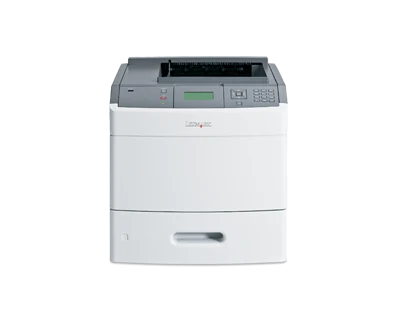
Your needs, this model
Does it fit your priorities?
Can Ethernet combine A4 duplex, 650 included sheets and PIN release at 25,000 monthly pages?
Yes with compatible confidential-print software. A4 duplex is explicit; load 550 ordinary A4 sheets in the drawer and 100 in the feeder, with matching settings and Cassette mode for linking. The recommended ceiling is 30,000 pages/month.
Explore this need in the finder →Can USB support Legal duplex and occasional envelopes at the declared 50-ppm Letter minimum?
Yes. Legal fits the automatic-duplex path; envelopes use a separate one-sided multipurpose-feed job. The selected rate checks the 50-ppm one-sided Letter declaration, not Legal or duplex throughput.
Explore this need in the finder →Does its Ethernet port also provide a document feeder for computer scanning?
No. The T652dn is print-only. Its multipurpose feeder handles blank print media and does not scan originals.
Explore this need in the finder →Built-in duplex for a wired document team
The Lexmark T652dn combines included Ethernet and USB with an internal automatic-duplex unit. US part 30G0200 is a monochrome laser printer for a team producing ordinary reports, forms and correspondence within the maker's 3,000–30,000 recommended monthly pages. It declares up to 50 one-sided Letter pages per minute.
Its 650-sheet standard input is useful when understood correctly: a 550-sheet drawer plus a 100-sheet multipurpose feeder. The separate 350-sheet output bin can still need attention before a full input load finishes. This is a print-only model, so paper capture, copying and fax require different equipment.
Set up both paper sources for the intended work
The original media tables support Letter, Legal and A4 in the drawer and multipurpose feeder, and in the installed duplex path. The ordinary input figures use the 20-pound or 75-gsm basis. Adjust the guides, respect the fill lines and match paper size and type in the panel and computer software.
To use both sources for a linked ordinary-paper run, load the same stock and settings and put the multipurpose feeder in Cassette mode. It is not another enclosed drawer. Its door and extension need working space, and its size setting requires deliberate configuration. Incorrect linking can produce the right document on the wrong stock.
Suitable envelopes use a separate multipurpose-feed routine with the stated flap orientation and Envelope type. They replace its ordinary-paper load for that job and do not use duplex. An optional envelope feeder, finishing units and the 4,300-sheet input maximum all require additional hardware rather than describing the supplied printer.
Distinguish one-sided speed from duplex output
Lexmark declares up to 50 Letter pages per minute for one-sided printing and separately 34 Letter sides per minute for automatic duplex. These are different modes and units. They are not measured completion times for an application file, and the Letter declaration should not be treated as an A4 or Legal speed.
The guide shows software controls for one-sided or two-sided output and long-edge or short-edge binding. Check the actual driver and a representative report, including any preprinted letterhead. Loading orientation changes with duplex and can also change when an optional finisher is installed.
Release confidential pages at the keypad
Compatible Windows Print and Hold or Macintosh Job Routing software can submit a confidential job with a user name and four-digit PIN. At the printer, choose the held job and enter the PIN before releasing it. The four-line grayscale panel provides status and menu navigation; it does not turn the printer into a scanner.
The documented confidential routine stores jobs in printer memory, where they may be deleted under memory pressure. It does not state that an optional hard disk is required. Disk encryption and the separate Job Waiting feature do depend on optional storage, so keep those requirements distinct from ordinary PIN release.
Verify the connection and supplies before reuse
The included computer routes are USB Type-B and 10/100 Ethernet. The front Type-A socket accepts supported flash-drive files. For wired setup, print the network page, confirm Connected status and use the correct IP address and driver. Parallel, serial, gigabit and wireless options are separate equipment; AirPrint and Mopria are unestablished here.
The exact US supplied Return Program cartridge declares 10,000 pages. Standard T650A11A or T650A21A replacements declare 7,000, while T650H11A or T650H21A high yields declare 25,000 under ISO/IEC 19752. The larger 36,000-page cartridges belong to T654 models. Check supply region, program conditions and maintenance-kit status as well as toner.
The 225,000-page maximum duty figure does not replace the 30,000-page recommended monthly ceiling. Lexmark marks this 50.7-pound printer discontinued. Verify its electrical label, proper cord, software, physical condition and installed options, allowing operating clearance. Compare a documented multifunction or wireless model when either would remove extra equipment from the daily setup.
Key details at a glance
| Color printing | No |
|---|---|
| Scanner | No |
| Copying | No |
| Fax | No |
| Flatbed scanner | No |
| Automatic document feeder | No |
| Automatic two-sided printing | Yes |
| Automatic two-sided scanning | No |
| Single-pass two-sided scanning | No |
| Color scanning | No |
| Instructed envelope handling | Yes |
| Supported PIN-release printing | Yes |
| Recommended monthly minimum | 3000 pages |
| Recommended monthly maximum | 30000 pages |
| Maximum monthly duty | 225000 pages |
| Included ordinary-paper capacity | 650 sheets |
| Declared one-sided mono Letter rate | 50 pages/min |
| Unit-body width | 16.7 in |
| Unit-body depth | 20.1 in |
| Unit-body height | 16.8 in |
| Unit weight | 50.7 lb |
| Imaging engine | laser |
Use the exact model’s instructions for operating limits, supplied equipment and version differences.
Paper, software and setup details
Print-rate conditions
Maker maximum 50 one-sided Letter pages per minute; automatic Letter duplex is separately 34 sides per minute. Declared modes are not measured complete-job throughput.
Paper handling
Included 550-sheet drawer plus 100-sheet multipurpose feeder total 650 ordinary sheets at 20 lb/75 gsm. Letter, Legal and A4 fit both and the automatic-duplex path. To link the feeder, use Cassette mode and matching size/type. Envelopes replace its ordinary-paper load for a separate one-sided routine. Maximum 4,300 needs optional hardware; output is separately 350 sheets.
Scanning arrangement
Monochrome print-only laser hardware has no scanner glass, document-capture feeder, copying or fax. Multipurpose paper feeding and a front flash-drive port do not capture originals.
Computer and mobile connections
Included USB Type-B computer interface and 10/100 Ethernet. Front Type-A accepts supported flash-drive files. Parallel, serial, gigabit and wireless hardware are optional. Current mobile protocol support is unestablished.
Supplies and declared yields
Exact US supplied Return Program cartridge declares 10,000 pages. US/Canada standard T650A11A/A21A replacements declare 7,000 and T650H11A/H21A high yields declare 25,000 under ISO/IEC 19752. Extra-high 36,000-page cartridges are restricted to T654 models. Check maintenance-kit/fuser type and voltage separately.
Software and support
Compatible Windows Print and Hold or Mac Job Routing software can submit a confidential job with a four-digit PIN, then release it from Held Jobs using the panel keypad. Jobs occupy printer memory and may be deleted under memory pressure. Disk encryption and Job Waiting need the separately optional hard disk. Current OS, AirPrint and Mopria compatibility are unestablished.
Electrical edition and setup
Inspect actual electrical label, proper cord and installed condition; nominal mains input is unestablished. The 50.7 lb body requires operating access beyond its dimensions. Paper expansion/finishing can need suitable furniture; verify installed options and driver configuration through the menu settings page.
Sources for this assessment
Find a printer for your routine.
Match color output, scanning, connections and paper handling, then compare the exact models.