
Your needs, this model
Does it fit your priorities?
Can an Ethernet office scan Legal originals in color from both the glass and automatic two-sided feeder, copy them and use analog fax?
Yes with the documented network scan profile and compatible software. Both physical routes accept Legal; the feeder reverses pages. Fax separately requires the LINE connection to active compatible analog telephone service.
Explore this need in the finder →Can a wired team print Letter duplex reports with PIN release, 650 included sheets and a 9,000-page monthly routine?
Yes. Letter duplex is explicit, confidential jobs use compatible computer software, and the recommended ceiling is 10,000 pages/month. Match ordinary stock and size/type across the tray and MP feeder.
Explore this need in the finder →Does its automatic two-sided ADF meet a single-pass Legal scanning requirement?
No. The exact X736de specification identifies a reversing duplex ADF, which scans both sides automatically using a different mechanism from single-pass capture.
Explore this need in the finder →Color office work with a genuine Legal-size scanner
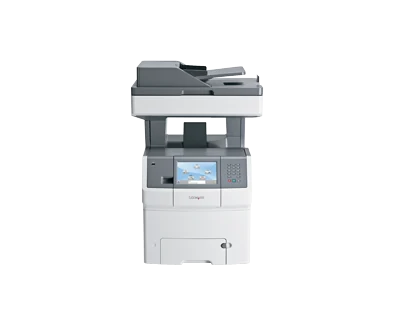
The Lexmark X736de is an earlier color laser multifunction machine for an office that combines printing, copying, network scanning and analog fax. US part MS00301 includes a 7-inch color touchscreen, a 50-sheet reversing document feeder and a scanner glass that explicitly accepts originals through 8.5×14 inches. That glass can matter when a Legal original is unsuitable for the feeder.
Its recommended monthly range is 3,000–10,000 pages. Included Ethernet supports the documented computer-scanning arrangement, while Wi-Fi and a hard disk are optional. The feeder automatically scans both sides by reversing the sheet; choose a documented single-pass alternative when that different mechanism is essential.
Match the original to the right capture route
Place ordinary multipage originals faceup, short edge first, in the ADF and adjust the guides. The guide supports documents from approximately A5 through Legal, including Letter and A4, with a 52–120-gsm feeder range. Set the original size, color and sides correctly before starting a two-sided job.
The glass accepts individual pages or books up to the documented one-inch thickness, with the original facedown in the upper-left corner. Small items, photos, transparencies and thin clippings belong there rather than in the feeder. Copying can use either route, with the output size and sides chosen independently from the original.
For computer scanning, the documented network routine creates a scan profile from the printer's Embedded Web Server. Choose settings and a destination on the computer, then select the profile or shortcut at the machine. Confirm that the actual computer, browser and network permit this older workflow. The USB computer-print connection alone does not establish a USB scanning setup.
Use the paper capacity and duplex evidence carefully
The included 550-sheet drawer and 100-sheet multipurpose feeder provide 650 ordinary sheets on the maker's 75-gsm or 20-pound basis. The original table supports Letter, Legal and A4 in both. For combined feeding, load matching stock and size/type settings and use the feeder's Cassette mode.
Automatic Letter duplex is explicitly supported, including a declared black duplex speed. The reviewed paper-size table labels its measurements for one-sided printing and does not establish a complete automatic-duplex size subset. Check the actual guide and driver choices before relying on another specific size for two-sided output.
Suitable envelopes use the multipurpose feeder's separate instructed load and settings, replacing its paper stack. The 250-sheet output bin is smaller than the total ordinary input. The 3,200-sheet maximum input requires additional hardware; it is not the supplied configuration.
Keep printing, confidential release and telephone fax distinct
USB Type-B connects a computer for printing, and included 10/100 Ethernet supplies wired networking. Lexmark says the interface also works on 1000Base-T networks; that compatibility does not make it a gigabit transfer-rate claim. Front and rear host ports and PictBridge support have their own device purposes.
Compatible Windows Print and Hold or Macintosh Job Routing can submit a confidential job with a four-digit PIN for local release. The guide documents this in printer memory, so ordinary PIN release does not require assuming the optional disk. Held jobs can be removed when memory is needed. Sample Copy is a separate feature for which the exact page requires the hard-disk option.
The analog fax modem uses an active compatible telephone service connected to LINE. Configure the station name and number and follow the appropriate regional connection instructions. Ethernet does not replace the phone path, and a digital telephone service may require its own suitable equipment and provider setup.
Assess workload and the remaining service items
Lexmark declares up to 35 one-sided Letter pages per minute in black or color and separately 23 black Letter duplex sides per minute. Scanning has separate figures, including 12 sides per minute for reversing duplex. The 85,000-page maximum monthly duty rating should not replace the recommended 10,000-page ceiling.
The original US toner declares 6,000 black and composite CMY pages. Replacements declare 8,000 or 12,000 black and 6,000 or 10,000 CMY pages under ISO/IEC 19798 on the maker's continuous basis. Check the photoconductors, waste box, voltage-specific fuser, transfer module and ADF wear parts as separate items. This discontinued 97-pound model also needs electrical, software and operating-clearance checks before reuse.
Key details at a glance
| Color printing | Yes |
|---|---|
| Scanner | Yes |
| Copying | Yes |
| Fax | Yes |
| Flatbed scanner | Yes |
| Automatic document feeder | Yes |
| Automatic two-sided printing | Yes |
| Automatic two-sided scanning | Yes |
| Single-pass two-sided scanning | No |
| Color scanning | Yes |
| Instructed envelope handling | Yes |
| Supported PIN-release printing | Yes |
| Recommended monthly minimum | 3000 pages |
| Recommended monthly maximum | 10000 pages |
| Maximum monthly duty | 85000 pages |
| Included ordinary-paper capacity | 650 sheets |
| Document-feeder capacity | 50 sheets |
| Declared one-sided mono Letter rate | 35 pages/min |
| Declared one-sided color Letter rate | 35 pages/min |
| Unit-body width | 21.5 in |
| Unit-body depth | 24.5 in |
| Unit-body height | 31 in |
| Unit weight | 97 lb |
| Imaging engine | laser |
Use the exact model’s instructions for operating limits, supplied equipment and version differences.
Paper, software and setup details
Print-rate conditions
Maker maximum 35 one-sided Letter pages per minute in black or color; separately 23 black Letter duplex sides per minute. Letter simplex scanning is separately 35 sides/minute, reversing duplex scanning 12 sides/minute. Scan rates and color-quality figures are not print speeds.
Paper handling
Included 550-sheet tray plus 100-sheet MP feeder total 650 ordinary sheets at 75 gsm/20 lb. Letter, Legal and A4 fit both; match size/type and use MP Cassette mode for combined feeding. Letter automatic duplex is explicit; a complete exact-size duplex list is unestablished. Envelopes use their own MP load. The 250-sheet output and optional 3,200-sheet maximum input are separate.
Scanning arrangement
Color scanning uses a 50-sheet reversing ADF or scanner glass, both explicitly handling originals through 8.5×14 inches, including Letter, Legal and A4. This is automatic reversing duplex scanning, not single-pass. Photos, thin sheets and small fragile items belong on the glass.
Computer and mobile connections
USB Type-B computer printing and included 10/100 Ethernet are distinct from front/rear Type-A host ports. The Ethernet interface also works on 1000Base-T networks; that is not a gigabit transfer-rate claim. Wi-Fi, serial and parallel need optional hardware. Reviewed computer scanning uses a network profile; USB computer scanning and current mobile protocols are unestablished.
Supplies and declared yields
Original US supplied toner declares 6,000 black and composite CMY pages. Replacements declare 8,000/12,000 black and 6,000/10,000 CMY pages under ISO/IEC 19798 on the maker’s continuous basis. Photoconductors, waste toner box, fuser, transfer module and ADF wear parts are separate items.
Software and support
Create the documented scan profile from a reachable network computer, choose its destination and scanning settings, then release the profile at the printer. Compatible Windows Print and Hold/Mac Job Routing supply four-digit confidential release from printer memory. Held jobs can be deleted under memory pressure. Current OS and browser support require verification.
Electrical edition and setup
Analog fax uses the LINE port and an active compatible analog telephone service, with station name/number configured; Ethernet does not replace that telephone setup. Check offered-unit power labeling, proper support, operating access, software and component condition. Nominal mains input is unestablished.
Sources for this assessment
Find a printer for your routine.
Match color output, scanning, connections and paper handling, then compare the exact models.